
Clayton State Head Men’s Basketball Coach Carl Little Discusses His Military Service and How His Drill Sergeant Experience Helps Him Motivate and Get the Best from His Players
(November 8, 2026) - Clayton State University’s new Head Men’s Basketball Coach Carl Little shared memories and highlights from his 20-year military career as he looks forward to Veterans Day and the start of the Men’s Basketball season.
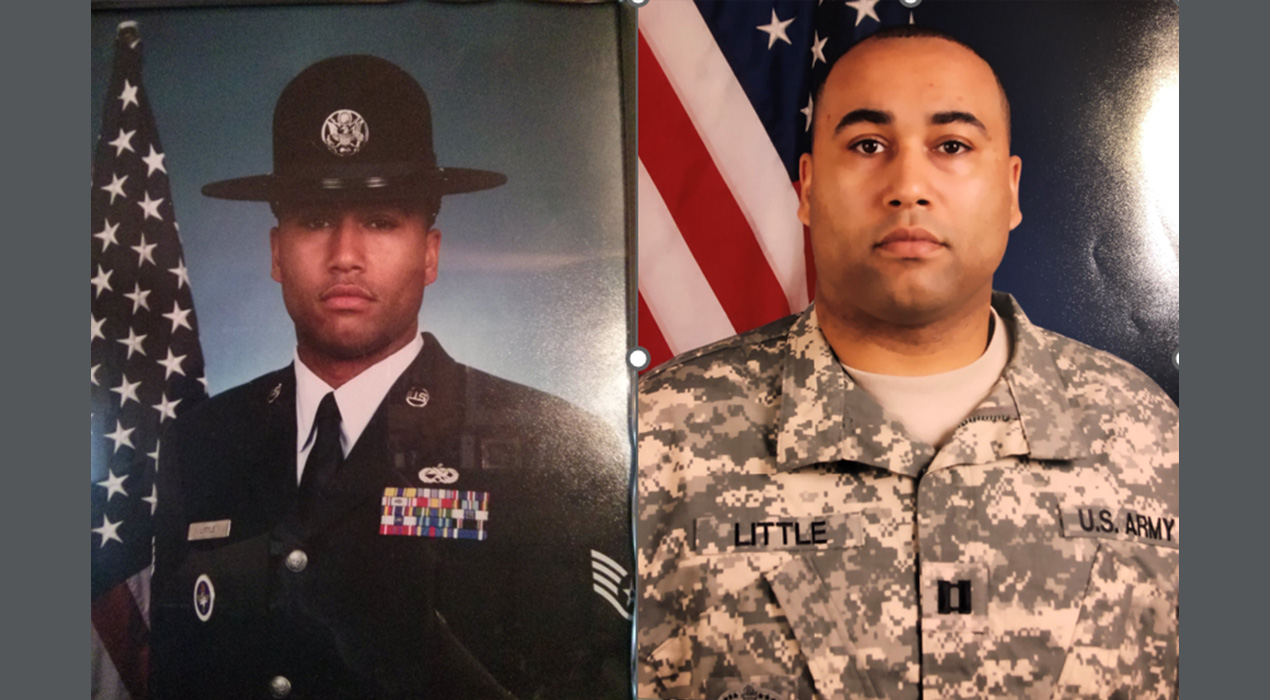
Like many young people who consider joining the military, Little had a family history of service. “My stepdad was in the Army; my dad was in the Air Force. So, I had some inspiration from my dad and my stepdad as far as serving. I made that career change and chose the Air Force. I went down, talked to the recruiter, and was able to ship off quickly for basic training. I was able to be in the role of aircraft armament, just load missiles and bombs on F-16s, and I really enjoyed it.”
When Little first signed up for military service, he never imagined it would turn into a 20-year career. He shared, “My original plan was just to do my four years and get out, go back to school, but I ended up liking it. I found a passion for basketball there and was able to play some professional ball overseas while serving and representing my base. Every base when I first came in typically had their base team, your varsity team, and you went around, and you played other bases.” He added, “It kept me in the service. It kept my motivation to want to stay. And then I met my wife and was able to just make this thing a career. You get to that 10-year mark, and then you kind of decide, hey, do I want to get out and do something else or just kind of stick it out? So, I decided to stick it out.”
His first stop in his military career was for basic training at Lackland Air Force Base in Texas. He shared, “I think the furthest place I had been was Canada on a church trip to Niagara Falls. But I had never been on an airplane. It was my first time on a plane.” Little went on to describe his basic training experience. He said, “it was 6 1/2 weeks long. You're up early in the morning, 4:45 am, and the reveille is going off. Get up, get your PT and physical training. And then basically, it's up doing daily tasks, classes, outside, field training. It wasn't difficult for me at all because I grew up with my mom. A lot of people say that was my first drill sergeant. I told my drill sergeant that once. So, when he was screaming, he was like, Little, you act as if none of this fazes you. I told him, “I’m used to it.”
Little received his first assignment after basic training, and it wasn’t what he imagined. Little said, “My first duty station was Aviano Air Base, Italy. And I had never been overseas. I was trying to trade with people to stay stateside. I really wanted to go back to Langley; I wanted to get to Langley Air Force Base, go back home, and do the college thing and military thing, but it didn't work out like that. God had other plans. So, I'm in Italy at 19, about to be 20 years old. I'm playing professional basketball over in Italy, like a lower-league professional. I'm playing for the base team over there, and we're traveling around, playing different teams and going to different tournaments in Europe as a team. So that really was an eye-opening thing for me. It's like, oh man, sports exist in the military.”
One helpful thing when arriving in a new country is that the military provides introductory classes to get you up to speed. Little said, “You got to go to a three-week-long course, and they indoctrinate you into living on your own and then, two, the culture that you come into. So, we had this class called Benvenuti. An Italian woman came and taught us the basic customs and courtesies of the country you're in. It was the first time I had heard of a siesta. Most places and stores in Italy close from about 11:00 am to 2:00 pm. They go home and have lunch with their family. We also learned about the traditional foods and meals. It was a very different but an exciting time.”
Little was there during a historic time in American history that sent him into combat missions. He said, “I think when September 11th happened, I was in Italy. I had just got back from a deployment to Turkey. We were flying missions there. And we got back, and at the time I saw the news and saw the gates closing. We went to Threatcon Delta, which is the highest alert, and I got a call from my supervisor. He said, “Make sure you have your bag ready. It's possible we may have to go back to Turkey within 72 hours.” So that did happen, and we were back on a C5 going back to Turkey with our jets, just on standby until the president said we were going to execute missions in Afghanistan.”
After his tour of duty in Italy, Little was assigned to a one-year tour in Korea. He said, “We all know we're training; every quarter you do a chemical warfare exercise to know that, hey, this can happen at any given time. You got to be on alert. That's when I met my wife. She was in the Air Force as well. We ended up extending over there so we could go to our next duty station together. I then went to Okinawa; my wife and I went to Kadena Air Force Base.
At the ten-year point in his career, Little said, “I was in the Air Force and back at Lackland Air Force Base. I was a drill sergeant at this time. I finished my degree, took the Air Force Officer Qualification Test, and scored well. But my degree, my undergrad degree, was interdisciplinary studies with a focus in education.” He couldn’t move up in rank in the Air Force at that time because of the type of degree they required. Little said at that time, “I met an Army recruiter, and he was kind of saying, hey, man, I can get you to Officer Candidate School. You won't have a break in service. I think it'd be a great transition. August 2nd, 2010, was my last day in the Air Force. August 3rd, 2010, I was in the Army at Fort Benning, Georgia, getting ready to go to Officer Candidate School.”
Coach Little said that, looking back on his military career, he enjoyed his time as a drill sergeant most. He said, “A lot of people think that a drill sergeant is just a person that just yells, right? Not everybody responds to that. I had a mentor tell me, Little, you don't want people to follow you because they have to. You never want that. You want people to follow you because they want to, and they want to work for you and want you to help them be the very best. So, it changed my approach. He told me that, and it changed my whole aspect of leadership.” Little took that learning into his next career as a collegiate basketball coach.
Little said, “I was coaching the All-Army team at the time, and I was also coaching at Columbus State part-time, and I knew I wanted to coach college basketball. And the one thing about this college basketball is the longer you are out where you're not doing it full time, the tighter your window gets. And I knew once I hit retirement, I'm gone. And I'm going to college to coach basketball.”
Clayton State University Head Men’s Basketball Coach Carl Little starts a new chapter in his professional career on Monday, November 9, at 7:00 pm, in Morrow, GA, at The Loch and Mason Barfield Court as the Lakers take on Andrew College’s Fighting Tigers.